Leading in a volatile world. Why business must embrace experimentation

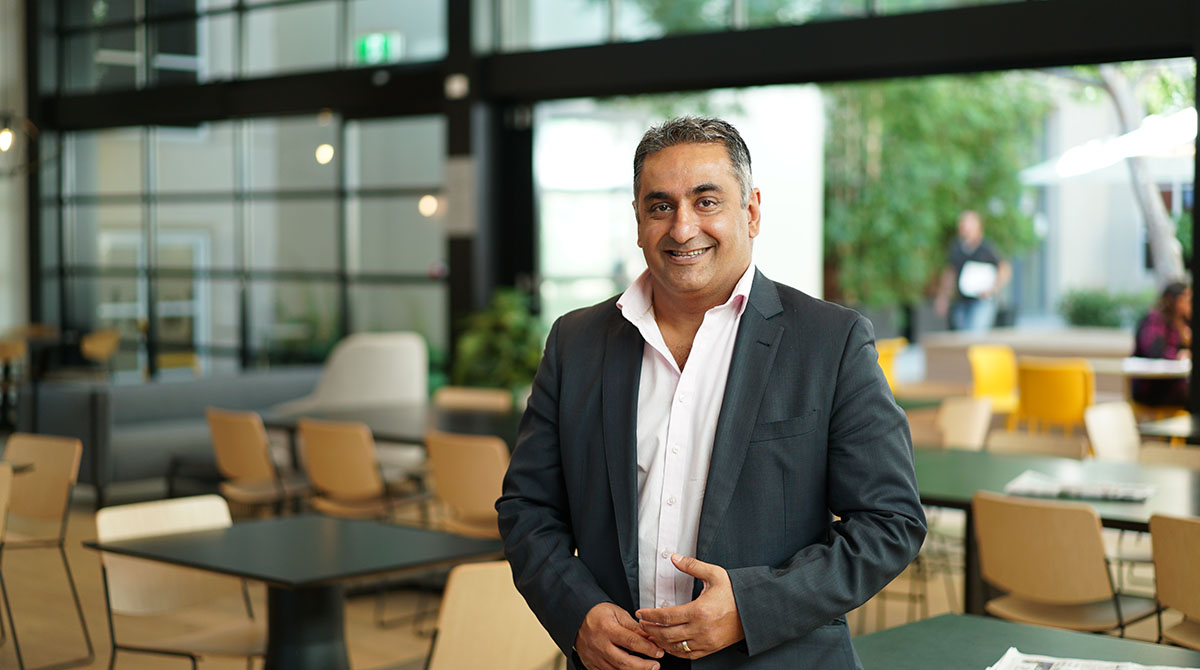
Associate Professor of Strategy Vivek Chaudhri explains how a US Military concept may be the key to business strategy in this rapidly changing landscape.
Over the last few decades, business strategy has focused on the importance of “sticking to your knitting” and not deviating too far from your core competencies.
Focus has been the mantra of businesses around the world.
But according to Associate Professor of Strategy Vivek Chaudhri, in a world that is changing rapidly, sticking to your core could render you ineffective in tomorrow’s world.
“In the past you would be able to map strategy or value creation for the firm in a world where you could be reasonably confident that the global trade architecture would be robust for the next 5, 10, 15 years and pick supply chains off the back of that,” Associate Professor Chaudhri said.
“We can’t really do that today because we don’t know what the bilaterial and multilateral trade system is going to look like in the next couple of years. And that is just one vector of change.”
So how do we deal with managerial decision making in a world where we can’t predict the future?
The answer might lie in embracing the VUCA framework (Volatility, uncertainty, complexity and ambiguity), popularised by the US military after the end of the Cold War.
“When the US were going into Afghanistan, they realised there were things that they could map out, things they could predict, things they could try to estimate like geographic terrain and social coalitions, but also a lot they just couldn’t,” Associate Professor Chaudhri said.
“In a military setting or any strategy setting, it’s useful to map out the boundary between the known knowns, the known unknowns and the unknown unknowns.”
Of the VUCA acronym, the one that is most helpful for senior business leaders today, he says, is the A or the ambiguity piece.
The world is changing in more ways than one
Every preceding generation has experienced technological, social and economic disruption.
However, Associate Professor Chaudhri argues what’s new today, is the scale and dimensionality of change.
“It’s not just technology and what does a generative AI enabled workplace look like,” he said.
“We’re also thinking about demographic change, geopolitical changes and the importance of localisation versus globalisation.”
We’re seeing change in so many different domains at one point in time that it renders the landscape in which firms are making strategy and value decisions harder and inherently unstable.
Why risk management in uncertain times is a losing battle
Traditionally, risk management might have meant assigning probabilities to different outcomes.
But as economist Frank Knight highlighted 100 years ago, risk and uncertainty are not the same thing.
“Risk, he postulated, is when you can attribute probabilities to future states, and uncertainty is when you either don't know the future states or you don't know the probabilities,” Associate Professor Chaudhri said.
We do not know what futures are going to look like, and even if we could anticipate the different states, we can’t put probability distributions in any meaningful way around those.
It means leaders must think of value creation in fundamentally different ways.
Embrace experimentation and a learning mindset
Rather than focusing on the “right path” Associate Professor Chaudhri encourages leaders to be willing to explore, experiment and learn different possibilities.
“Alphabet, Microsoft, Meta and many of the most profitable companies in the world, are taking other bets through what are sometimes called their moonshots division, and looking at things that are a long way from their core,” he said.
“Google still makes enormous revenue off search, but they are exploring autonomous vehicles and healthcare and all kinds of interesting things that wouldn’t fit the standard boundaries of sticking to your knitting.”
But to experiment effectively, Associate Professor Chaudhri says businesses must repurpose their organisational architectures that are not only designed for operational excellence but for experimentation and learning as a pathway to value creation.
Building ambidextrous organisations
For businesses to not only exploit value in the world today but explore value for the world tomorrow, Associate Professor Chaudhri says we must build the architecture for ambidextrous organisations.
“The idea of an organisational architecture is that I need incentives and contracts, structure and culture to interact with each other,” he said.
“If we got back to the 90s and early 2000s, many CEOs built their companies and reputations around operational efficiency and excellence, but they weren’t necessarily focused on innovation and experimentation,” he said.
“Tomorrow’s leaders have to proactively build that in as part of their organisational architecture and think ‘how do we allow people to experiment, take big bets, fail but also learn from that failure’.”
Reframing how we view failure
It’s not just that the Metas and the Alphabets have large amounts of cash to play with that allows them to experiment.
“That helps but it’s also that they’ve got a mindset around learning that allows for things not to work,” Associate Professor Chaudhri said.
“The measure of success isn’t just project outcomes but it’s what we learn from failure that allows us to explore value tomorrow in different ways.”
He said Australian companies tend to be relatively conservative when it came to experimentation as firms favour innovations that are easy to measure in the short-term.
Changing this mindset meant not just rewarding incremental advancements but allowing for bigger bets to take place and importantly, accepting some will fail.
“When we talk about failing, I think we have embedded in it an idea of win, lose or success and failure,” Associate Professor Chaudhri said.
“Whereas if we have learning as the nomenclature we use, that changes the way we approach things as an organisation.”
Leading in a VUCA world
The biggest application of the VUCA framework today is getting clarity around what is knowable at a point in time and what isn’t.
“It’s not about moving from confidence into arrogance and pretending we know things that are just fundamentally unknowable at a point in time,” Associate Professor Chaudhri said.
“For leaders it’s having the courage to say to their teams, to their capital markets, the board and whoever else they’re trying to influence that this is within the bounds of what we know, and this is what we should do and why,” he said.
And as more information comes along, leaders must be willing to pivot, change direction and decide to do something else.
“The term I like to use is ‘courageous humility’, having the courage and the humility to say what’s knowable and what isn’t at a point in time,” Associate Professor Chaudhri said.
“And if we accept the VUCA premise and the Knightian uncertain world, there’s going to be a lot we can’t know and it’s okay to say, ‘I don’t know’.”
Associate Professor Vivek Chaudhri teaches strategy on Melbourne Business School’s Degree and Executive Education programs. Vivek was a strategy adviser to the CEO of CSL and MD of Grannus Securities and his research has been published in leading journals, including the Academy of Management Executive, Australian Journal of Agricultural and Resource Economics and Administration and Society.