
The MBA graduate chasing a startup dream

After 16 years as an Australian Army Engineer, Joel Bell swapped the uniform for a shot at building a startup in America.

“I grew up in an asbestos shack on the edge of the Australian desert. My dad was a carpenter, and my mum never graduated high school.”
That's how Joel Bell, president and co-founder of US construction-tech startup Benchmark, described his childhood in Red Cliffs, a small town near Mildura.
The Australian Army was his ticket to university and the start of the next 16 years in uniform. That’s how his story starts, but from there it was a Full-Time MBA at Melbourne Business School, and a leap to North Carolina to start a business using AI.
Sixteen years in the Australian Army
Bell studied civil engineering at the Australian Defence Force Academy, commissioned into the Royal Australian Engineers, and worked his way to Major. The unique opportunities during his service included training as an Army Diver, running a program delivering infrastructure to remote Indigenous communities, and building schools in East Timor. He deployed twice: eight months in Afghanistan in 2016, then eight months based in Dubai in 2021.
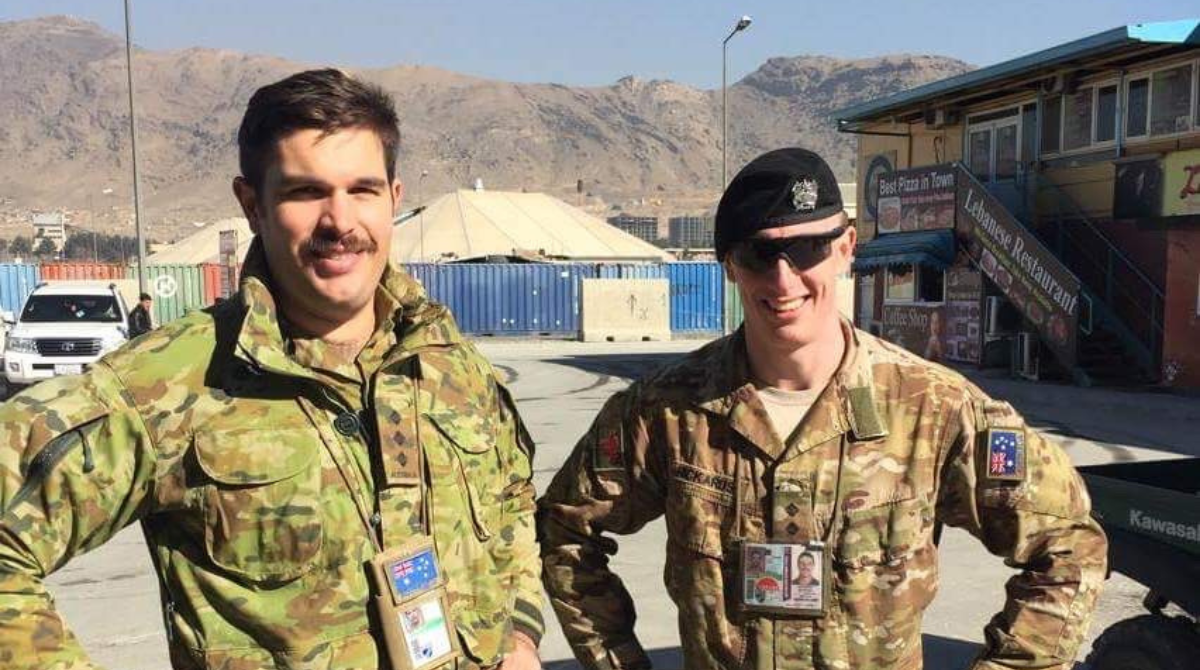
That second deployment put him at the centre of the evacuation of civilians from Kabul as the Taliban retook the city. It was the proudest moment of his Army career.
“The real standout was when we did the evacuation from Kabul. That was a really extraordinary thing to be part of. The entire world was watching what we were doing. As a team, we evacuated over four thousand people. I kept in touch with a few of them. They've gone and had kids, who are now starting school in Australia.”
A new mission: the business world
It's a well-known story for veterans: the transition into civilian life is often a difficult path. Joel Bell felt the loss of identity.
“It's just so much a part of who you are. The way you speak, the way you dress. Even now, I tie my shoes a certain way because that's the way we were taught to do it in basic training.”
Most of his engineering peers moved into project management or consulting after the Army.
“Being an Army Officer makes you really well suited to consulting, particularly public sector work,” he said.
“But I had absolutely no interest in those roles. I would have been doing the same thing I did in the Army, just wearing a suit instead of a uniform.”
He leaned on mentors to help him navigate the transition. A former Air Force officer in his mid-60s who'd done an MBA of his own, told Bell it had made him much more multi-dimensional. Bell realised an MBA could do the same for him and open a much wider range of opportunities.
He chose Melbourne Business School because it was ranked #1 in the country, and that pedigree mattered to him.
The exchange that changed everything
He also chose Melbourne Business School for its global exchange program.
“The school has a much bigger exchange network to offer than others in Australia,” he said.
When the options came out, he picked North Carolina on a whim.
“I saw North Carolina and I went, that sounds fun. I didn't even know where it was on the map, so I had to look it up,” he said.

The exchange to the University of North Carolina at Chapel Hill turned out to be a pivotal point of his life. He met founders and business owners, took entrepreneurship electives, and met his partner, Courtney.
He also discovered a growing state with a research industry that is one of the top biotech hubs in the US.
“I came on exchange with a view to find an opportunity,” Bell said.
“I met people, made a point of just talking to a broad group, having coffees, and then thought: yeah, this is a place I could move to.”
After graduating the Full-time MBA in 2024, Bell needed a job to sponsor his visa in America. Based out of North Carolina, BotBuilt was a startup using robotics and AI to build house frames, aiming to make homebuilding quicker and cheaper.
“They were looking for someone like me at the same time I was looking for someone like them, so I reached out on LinkedIn,” he said.
Only a month after finishing his MBA, he joined the robotics startup as a director, building the software business inside the company.
The pivot that built Benchmark
It wasn't smooth sailing.
“This is a classic startup story,” Bell said.
“BotBuilt ran out of money. Robots are expensive and a half-million-dollar prototype robot is a difficult sales proposition.”
After roughly a year and nine months, Bell needed to pivot.
He recognised the software underneath was the real asset. Along with the company’s top two engineers, he pitched the board on turning the software into a standalone company. The board agreed and Benchmark was born.
That software reads construction blueprints and turns them into full 3D build-ready designs, 100% accurate estimates and engineered drawings.
“We can tell you to the nail how much material you need to build a house,” Bell said.
Customers use the data in bidding, manufacturing and structural analysis.
Bell has been president since February 2026.
Backed by a new round of funding, Benchmark now serves roughly 30 American lumber yards, as well as a growing roster of builders, framers, and component manufacturers. The company expects to become profitable in 2027 and sees a very large opportunity in the US residential construction space.
The MBA in practice
He credits the MBA with giving him fluency in the language of business.
“In a startup, where you're building from zero, it's the foundational stuff that matters most,” he said.
That fluency is what lets him sit across from other businesses and talk strategy in terms they trust.
Bell's advice to anyone weighing up an MBA is straightforward.
“Just do it. And consider doing the Full-time MBA rather than the part-time. There's a lot of value in dedicating focused, undistracted time to study.”

Full-time MBA
Management
Full-time MBA
Australia's top-ranked MBA in an immersive format that will develop your full potential to succeed.

MBA Exchange Program
Expand your horizons with our global network of more than 50 business schools across 23 countries.

