How will AI shape organisational power dynamics?

AI is already putting entry-level jobs at risk. But with its rapid evolution, Professor Nathanael Fast raises questions about how new power dynamics might alter the workforce even further.
For CEOs and executives in the upper levels of organisations, the experience of having power over other people shapes how decisions are made.
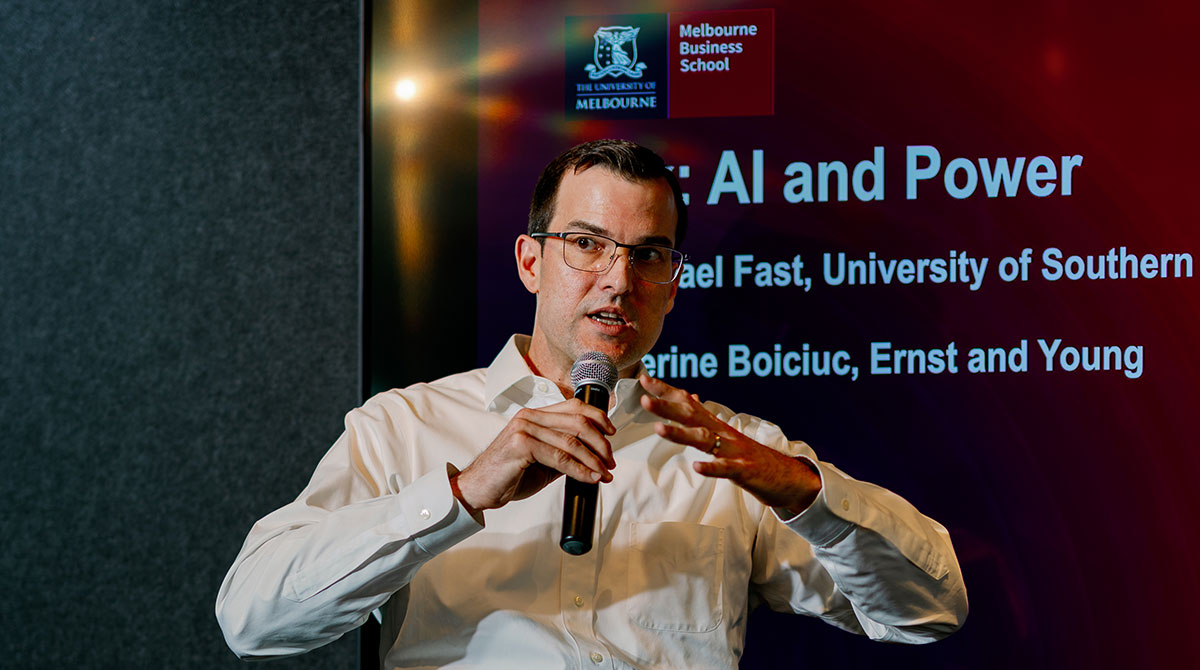
Professor Nathanael Fast, Executive Director of the USC Neely Center for Ethical Leadership and Decision Making at the University of Southern California’s Marshall School of Business, recently spoke at Melbourne Business School’s Power, Status and Influence Conference and explained that there are several consequences that stem from having power.
“One of the ways power shapes decision-making is that it leads to increased agency due to a perception of elevated control," he said.
"Our research even showed that having power strengthens the illusion of control people tend to have, leading to a sense that they can influence things that aren’t controllable.”
A second consequence of having power is an expectation that one ought to have greater competence than other people.
So, with the rapid adoption of AI potentially leveling the competency playing field there are questions about what it will mean for organisational power balances.
AI’s impact on power and agency
While AI can enhance a user’s sense of agency in decision-making and information gathering, Professor Fast says this doesn’t necessarily equate to more power.
“We have found that people feel more agency with relation to using large language models from getting information, making decisions, accomplishing general goals.
While there is some opportunity for people to feel more powerful at a personal level, this is often overridden by a broader distrust of the technology.
“I think some people feel a sense of powerlessness related to how AI is advancing,” he said.
“On the one hand, a worker might feel like they have more agency over their job when using an LLM to help them do their work, but in a bigger picture sense, they actually might be worried that their job is going to be replaced by it.”
Diminishing the talent pipeline
This fear is not unfounded, with AI increasingly being used to perform tasks previously assigned to entry-level employees.
“Upper management and more seasoned employees tend to be safer right now in terms of their jobs than entry-level workers,” he said.
“What we are seeing now is that some companies are giving middle-level or upper-level people large language models to use instead of hiring interns or recent graduates.”
While that hasn’t necessarily shifted the power dynamics, it’s removing or diminishing the pipeline of employees. “
What we might see in 5 to 10 years is a reduction in employees with the expertise necessary to truly contribute,” he said.
Is it really safer at the top?
While currently there is job security at the top, this too may well change.
The current speed at which AI technology is evolving makes it difficult for experts to keep up, let alone managers and executives with limited time.
The sheer number of AI tools available adds an additional layer of complexity to decision-making for organisational leaders.
“As an executive who is trying to make decisions, one is already strapped for time and somehow they’re supposed to experiment with AI models and dozens of tools and stay up to speed on a technology developing faster than anyone can track,” Professor Fast said.
In addition, there are currently no definitive answers or best practices for AI adoption.
“Nobody really has the right answers yet,” he said.
“So it really requires a lot of humility, a lot of experimentation and for leaders to carve out time to do personal research and development.”
With such a lack of clarity, there is a real risk that competency comes into question.
“When people in power feel good about their competence, they feel more optimistic and confident. Yet when they lack competence or feel inadequate, that can lead to ego defense mechanisms like aggression or derogation of subordinates,” he said.
“Given how fast AI is moving, there’s a higher chance they’re going to feel inadequate.”
Professor Fast likens the coming effects of AI on the workforce to an impending earthquake.
“It’s like tectonic plates that are ready and poised to move to create an earthquake,” he said.
“College graduates or younger employees who have been learning how to use AI could leap-frog those above them in the organizational hierarchy. On the other hand, those in power may seek to solidify their positions, making it harder for young workers to advance.
“One thing that is certain is that understanding how both AI and power works will be a huge advantage.”
Professor Nathanael Fast was a guest speaker at the Power, Status and Influence Conference 2026 hosted by Melbourne Business School.
To learn more about AI and secure your advantage, visit our sign up for AI for Business short course. Or visit our Institute for Digital Innovation and AI to learn how we are helping organisations navigate the opportunities and challenges of digital technologies and AI.