A Doctor, a Vision, and the AI Revolution Changing Australian Healthcare

From medical practice to machine learning - redefining how care gets delivered.
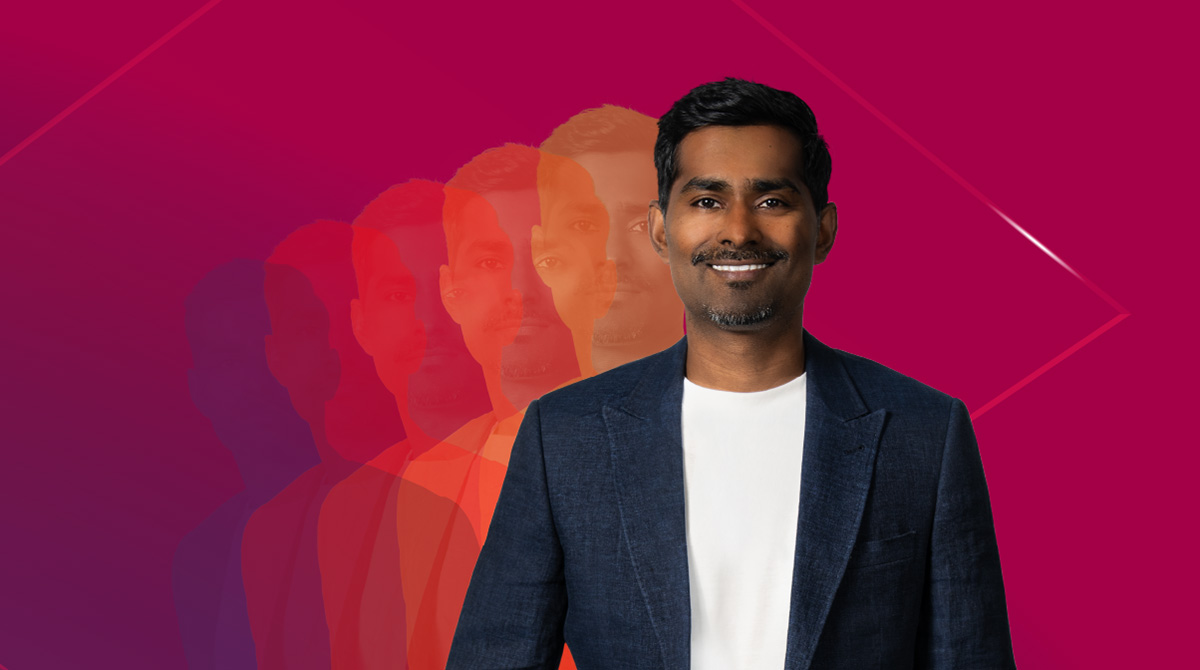
- Name: Dr Sudesh Piyatissa
- Current Role: Medical Doctor and Co-Founder, i-scribe (Akuru)
- Program: Part-Time MBA, Melbourne Business School
- Cohort: 2020–2024
From Care to Curiosity - The Start of a Bigger Mission
After fifteen years of medical training and practice, Dr Sudesh Piyatissa had achieved what many clinicians strive for - a career grounded in skill, care, and trust. But while he loved the one-to-one nature of medicine, he began to see an even bigger challenge: the inefficiencies that prevented clinicians from spending time where it mattered most - with patients. “I loved medicine, but I wanted to create change at a population level, not just one patient at a time,” he explains.
That insight became the seed for i-scribe, an AI-powered medical documentation platform built by doctors, for doctors. Designed to draft accurate, audit-ready patient notes in seconds, i-scribe frees clinicians from hours of administrative work - a breakthrough that’s transforming how healthcare operates. “Because it was built by clinicians, doctors trust it. And because it’s accurate, they rely on it,” he says. But as the idea took shape, Sudesh recognised a new kind of problem, one his medical training alone couldn’t solve. “I could diagnose clinical issues, but not business ones,” he says. “If I wanted to turn a good idea into a scalable company, I needed to understand finance, strategy, and systems - not just medicine.”
The realisation became clear: to change healthcare, he needed to learn the language of business. That’s what led him to Melbourne Business School.
Why Melbourne Business School
When it came to pursuing business education, Sudesh wanted the best. “For me, if I was going to dedicate this much time, it had to be worth it,” he says. “The time value of an MBA is significant, so I wanted an institution whose reputation would hold up anywhere in the world.”
Having earned his medical degree at the University of Melbourne, the decision to return to Melbourne Business School felt like a natural progression. “MBS has the strongest reputation in Australia. It’s the school that people in industry recognise and respect.”
That credibility, he says, became an important bridge between his medical world and the world of business and innovation - helping him “walk confidently into boardrooms as well as hospital wards.”
Inside the MBA Experience
Transitioning from the science-focused world of medicine into the diverse ecosystem of an MBA was both energising and eye-opening.
“For ten years I’d only studied and worked with other healthcare professionals. Suddenly I was surrounded by engineers, strategists, and consultants. It opened up parts of my mind I hadn’t used in years.”
That cross-pollination became the foundation of his learning. In syndicate projects, he collaborated with peers from law, strategy, and commerce, translating complex clinical problems into strategic opportunities.
From Practitioner to Founder
Sudesh describes his MBA as a spark - a catalyst that ignited new ways of thinking.
“I was fluent in the language of medicine,” he reflects, “but the MBA taught me to think in other languages too - strategy, innovation, leadership.”
The MBA became the bridge between two worlds: the precision of medicine and the adaptability of business. “Medicine teaches you accuracy; business teaches you agility,” Sudesh says.
Courses in entrepreneurship and innovation resonated deeply, especially as he began building i-scribe with his co-founders - two ophthalmic surgeons, an emergency doctor, and an engineer. Together, they created an intelligent platform that automates medical note-taking with unprecedented accuracy reducing hours of administrative work to seconds.
He credits MBS for giving him the frameworks and confidence to move from practitioner to founder.
Scaling Care Through Technology
Co-founded in 2023, i-scribe has grown from concept to a 38-person company in less than two years. Its AI-driven technology now ranks among the most accurate medical documentation tools in the market, trusted by clinicians across Australia.
“What started as a frustration became a solution. That’s the power of combining experience with new ways of thinking,” Sudesh says.
By blending clinical insight with business understanding, he’s helping reshape how technology and trust intersect in modern healthcare. Proof that the right idea, backed by the right education, can drive systemic change.
“It’s surreal to see something we built now helping clinicians across Australia,” he says. “That’s the kind of population-level change I always dreamed of.”
For Future Students
“Some people start the MBA knowing exactly where they want to end up. Others, like me, just know they want change. Both are valid.”
Sudesh encourages future students to embrace curiosity over certainty. “The MBA keeps you curious - about problems, about people, about yourself. That’s what drives real transformation.”
He says the program doesn’t just teach new skills, it rewires how you think. “It’s a process of unlearning as much as learning.”
Made. Not born. – Personal Interpretation
When asked what Made. Not born. means to him he reflects on it from a clinician point of view - “It’s about nature and nurture,” he says. “We’re all born with certain traits,” he reflects. “But it’s the opportunities around us, and what we do with them, that make us who we are.”
The MBA was that opportunity for me. It moulded me into someone who could make beneficial change to the Healthcare system, moving from an individual view, to a population level.”