
Full-time Master of Business Analytics
Our degree for aspiring data professionals, with a focus on personal skills as well as technical expertise.
Master of Business Analytics Program Overview
Become the analytics leader organisations are looking for.
Our Full-time Master of Business Analytics prepares you to turn complex data into commercial insight. In just one year, you'll develop the technical expertise, business acumen and leadership skills to solve real business problems and shape strategic decisions.
Graduates are recognised for their ability to bridge the gap between technical expertise and business strategy, with alumni building successful careers at organisations including Apple, Amazon, Microsoft, Woolworths and Suncorp.
Learn from world-leading academics, work with industry on real analytics projects and graduate ready to launch a career in one of the world's fastest-growing professions.
Why a Full-time Master of Business Analytics at Melbourne Business School?
#1 Master of Business Analytics in Australia
Melbourne Business School
QS Business Master's Rankings, 2026
Industry-based Project
One-year Program
Career Support and Connection with Industry
Student Experience
People come to Melbourne Business School because they want to study with the best.
We attract some of the brightest academics and professionals from around the world.
Our campus is just four tram stops from the Melbourne CBD in the centre of Carlton’s vibrant knowledge precinct.
We also provide exciting opportunities for self-development and peer networking outside of the classroom, such as co-curricular activities, clubs, prizes and industry events.
Success Stories

"My advice is to get involved in as much as you can. There are loads of clubs you can join, events to attend, and all sorts of different people from different backgrounds you’ll get to know."JACK LIN

"If you want access to world-class support and resources, and if you want to challenge yourself and get the most out of it, then study at MBS."AMY DING
"Studying the Full-time Master of Business Analytics has really helped me bridge the business and technical sides to deliver answers more clearly."EMMELINE WU
The Professional Development Program

Learn by solving real business problems with The Professional Development Program.
The Professional Development Program provides you with the soft skills needed to complete your transformation into the well-rounded analytics professional that employers want.
You will have the opportunity to complete a supervised industry project using real organisational data, applying everything you've learned to solve practical business problems while building valuable workplace experience.

Through the Professional Development Program, we prepare you for the job market and facilitate the transition from the classroom into the workplace.
JOHN GURSKEY
Director, Career Services
Melbourne Business School
Why Employers Choose our Graduates
Understand Business Strategy
Apply Advanced Analytics and AI
Translate Technical Insights into Commercial Decisions
Communicate With Leaders
Deliver Measurable Business Impact
Students Have Completed Projects With Organisations Including:

Subjects and Structure
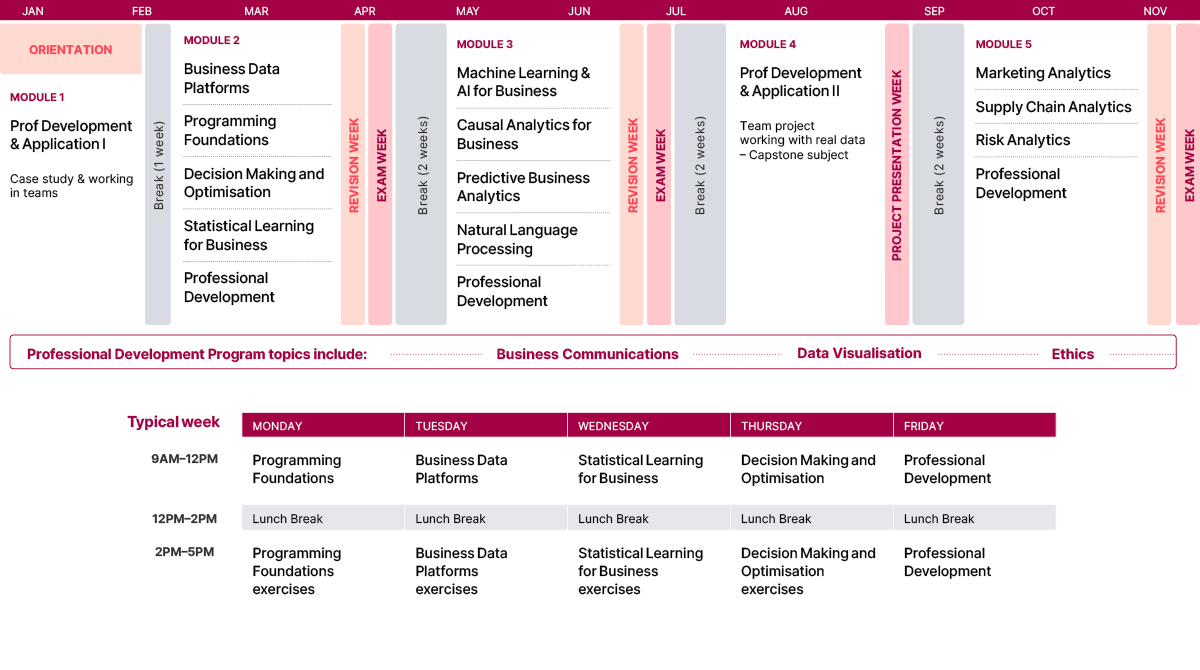
Module 1
Prof Development & Application I
This subject is designed to help students develop the skills and knowledge required to effectively manage the early stages of their career. This subject runs across roughly the first half of the full-time course and identifies specific needs of each individual student and then provides ongoing support, training, and opportunities to practice and perfect these skills.
Assessment of the subject includes a quiz on revisionary material, the writing of CVs, group work and group presentations as well as an essay involving ethical concerns within analytics.
The program focuses on four areas:
• Revisionary material: Rudimentary technical knowledge for the course.
• Communication skills: These skills include effective presentations, verbal communication, written communication, public speaking, and communicating technical material to non-technical audiences.
• Career development skills: These skills include interview skills, CV writing, networking, and business etiquette.
• Team skills: These skills include managing conflict, cultural awareness, giving and receiving feedback, and resilience.
These areas are the preparation for industry placement occurring in Professional Development II.
Module 2
Business Data Platforms
Data warehouses are designed to provide organisations with an integrated set of high-quality data to support decision-makers.
They should support flexible and multi-dimensional retrieval and analysis of data.
Topics covered include:
• data warehousing and decision-making;
• data warehouse design;
• data warehouse implementation;
• data sourcing and quality;
• online analytical processing (OLAP);
• dashboards;
• data warehousing for customer relationship management, and;
• case studies of data warehousing practice.
Programming Foundations
This component helps students, with little or no background in computer programming, learn how to design and write programs using a high-level procedural programming language, and to solve problems using these skills.
Topics covered include:
• cyber security, and;
• cyber ethics and privacy, regarding the collection of individual data.
Decision Making and Optimisation
This component helps students formulate a business problem as a mathematical model and then use computational techniques to estimate and solve the model.
Topics covered include:
• decision-making under uncertainty;
• optimal location/allocation of resources in business processes;
• decision trees;
• linear programming;
• integer linear programming, and;
• Monte Carlo simulations.
Statistical Learning for Business
The aim of this component, and the follow-on component in Module 3, is to help students learn how to extract relevant information from large amounts of complex data to make improved business decisions.
Topics covered include:
• data exploration;
• resampling methods;
• linear and nonlinear regression;
• parametric classification techniques, and;
• model selection.
Module 3
Machine Learning and AI for Business
This component builds on the material in Module 2’s Statistical Learning and covers advanced analytic methods. It extends the statistical-learning component of Module 2 in three ways.
First, new techniques, such as tree-based methods and neural networks, are introduced. Second, students are introduced to unsupervised statistical-learning techniques, and third, students learn how to combine models and techniques to produce ensembles with better predictive capabilities.
Causal Analytics for Business
Data Analytics models can be used to predict a performance variable. But many business decisions are not about predicting performance per se. They are about choosing the values of key inputs, such as price or advertising spend, to optimise performance. This requires that the effects of the inputs, as coded by the model, are causal. This typically requires further assumptions about how the data was generated.
The gold standard for establishing causality is a randomised experiment, which is becoming more common in business contacts. The course covers basic principles and practice of experimentation from A-B testing to randomised incomplete block designs. All these methods give rise to estimates of causal effects.
Predictive Business Analytics
Predicting key business and economic variables is increasingly important as it drives both objective decision-making and improved profitability.
This component aims to cover the main methods used to predict business and economic variables, based on historical data. These methods include traditional regression, time series, multivariate and econometric models, as well as emerging methods such as ensemble forecasts. Both point and density prediction will be considered, along with metrics for the quality of both. Throughout, the focus will be on introducing methods in the context of substantive business and economic problems using a wide range of prediction methods.
The importance of benchmarking different methodologies, and the use of prediction in decision-making frameworks, is also stressed.
Natural Language Processing
This component helps students develop an understanding of the key algorithms used in natural-language processing and text retrieval for use in a diverse range of applications, including search engines, cross-language information retrieval, machine translation, text mining, question answering, summarisation, and grammar correction.
Topics covered include:
• text normalisation;
• sentence boundary detection;
• part-of-speech tagging;
• n-gram language modelling;
• sentiment analysis;
• web mining and analysis;
• network analysis (including social network analysis), and;
• text classification.
Module 4
Prof Development & Application II
This subject, known within the degree as the Analytics-Lab, or A-Lab, involves practical experience for teams of students working on analytics project using data in or from an industry setting, typically undertaken as a five-week group internship.
The five-week project integrates academic learning with practical challenges in implementing data analytics, while developing employability skills and attributes, and improving students’ knowledge of organisations, workplace culture and career pathways.
The assessment week will involve the completion of a report for the subject and a project presentation.
Topics covered include:
Data analysis on datasets, investigating issues such as:
• Customer churn/loyalty;
• Logistics and supply chain;
• Forecasting demand;
• Optimal product or category portfolio;
• Marketing-mix optimisation;
• Credit risk;
• Employee selection, retention and training, and;
• Analysis of social media or other unstructured data sources.
Optimisation of processes, such as:
• Call centre operations;
• Logistics and delivery routes;
• Schedules;
• Allocation of marketing resources across products, and;
• Service delivery.
Module 5
Marketing Analytics
It has become increasingly important to know how marketing actions translate into revenue and profit growth. The tools that enable this translation are part of the toolkit called ’marketing analytics’.
Marketing analytics is a technology-enabled and model-supported approach to harness customer and market data and enhance marketing decision-making.
This component provides students with:
• knowledge of marketing analytics;
• the ability to know which analytics tools to use for which marketing problems;
• the ability to use those tools to solve marketing problems, and;
• the ability to influence marketing outcomes such as satisfaction, choice, loyalty, word of mouth, and customer referrals.
Supply Chain Analytics
Rapid advancements in technology (particularly the Internet), combined with fast and cheap computing power, has enabled firms to radically transform their industries by developing business models and re-engineering their supply chains.
This component provides students with:
• knowledge of mathematical modelling and analytic tools, relating to logistics and supply chain optimisation problems;
• the ability to use these tools and techniques to analyse strategic, tactical and operational decisions, pertaining to inventory management, facility location, logistics and other supply chain, management-related decisions, and;
• exposure to real world logistics and supply chain decisions through case studies.
Risk Analytics
Quantitative analytics have become an invaluable part of managing financial institutions, not only for profitability but also for safeguarding the organisation against risk.
In this component, students will be applying data-analytic skills to finance applications.
Topics covered include:
• financial performance benchmarking;
• modelling and computation of financial risks;
• dynamic portfolio management;
• computational derivative pricing; and modelling fixed income securities.
The focus of the component will be on both theoretical development and practical implementation, using contemporary data from the financial market.
Career Management Centre
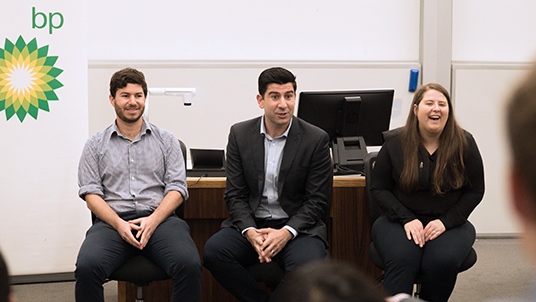
By partnering with leading organisations, our Careers Management Centre can connect you to top-tier firms in Australia and around the world.

Our career coaches will help you develop your job-hunting skills, maximise your future opportunities and increase your chances of success.
Meet With Us
The best way to learn more about studying at Melbourne Business School is to attend an upcoming information session or book a one-on-one conversation with our recruitment team.
We hold sessions monthly, providing a comprehensive overview of everything you need to know about the program, along with an opportunity to participate in a group Q&A session. After this, if you need more specific information on subjects and study materials, campus life or assistance with your application, please book a one-on-one session. We are available to meet in person at our Carlton Campus or online.




Investment
Program Fee
The program fees for the Master of Business Analytics program for the 2027 intake year are:
- Domestic: AUD $79,344
- International: AUD $97,920
Fees are paid per module in advance.
FEE-HELP
FEE-HELP is available to domestic students who meet the eligibility criteria.
Other Costs
International students:
- Please budget for Study visa fees and charges.
You must also obtain Overseas Student Health Cover (OSHC) for the duration of your stay in Australia. Melbourne Business School has selected Bupa as its preferred OSHC provider^.
The costs are:
- AUD $965* (Singles cover)
- AUD $4,161* (Couples/Single Parent cover)
- AUD $6,910* (Family cover)
^MBS receives a benefit for Bupa OSHC policies purchased through the school.
*Premiums quoted as at 30 June 2026.
Alternatively, you can choose to purchase OSHC from an approved Australian health insurance provider. You will need to contact the provider directly to set up your policy with them.
Scholarships
We have a wide range of scholarships available to support your study at Melbourne Business School.
Our scholarships encourage diversity, provide opportunity and reward talent.
When you apply for specific programs, you will automatically be considered for the scholarships available for that program. There are however certain scholarships where you need to make a separate application by a certain date.
For more information, visit our Scholarships page.
Entry Requirements
Admissions Criteria
To be considered for entry into this course, you must have:
- A 3 or 4-year undergraduate degree in a relevant discipline* with a minimum Weighted Average Mark (WAM) of at least 65% (or equivalent).
*Relevant disciplines include commerce, mathematics, physics, computer science, information systems, engineering and science.
You must submit:
- An up-to-date curriculum vitae (CV). Note: work experience is not mandatory.
- Evidence of all qualifications completed or incomplete including academic transcripts with grading schema.
- If you are in the final semester of your undergraduate degree, you may apply by submitting official academic transcripts showing your results to date for provisional assessment.
- Applicants who have not yet reached their final semester are not eligible to apply at this time.
- A passport or verified document showing current citizenship/residency status.
English Language Requirements
All applicants to the University of Melbourne must satisfy the English language requirements. This may be achieved in a number of ways, including recognised previous study taught and assessed entirely in English or an approved English language test. If you need to undertake an English language test, you must meet one of the scores below:
- IELTS (Academic English only): Overall score of 7.0 (with no individual band less than 6.5).
- TOEFL Internet-based test: Overall score of 91 (with writing 23; speaking 22; reading 19; listening 19).
- Pearson Test of English Academic (PTE): Overall score of 72 (with writing 65; speaking 66; reading 64; listening 64).
- Cambridge C1 Advanced: Overall score of 178 (with writing 180; speaking 187; reading 168; listening 168).
- LanguageCert Academic: Overall score of 73 (with writing 71; speaking 76; reading 65; listening 62).
- Michigan English Test (MET): Overall score of 62 (with writing 64; speaking 53; reading 59; listening 59).
About Selection
When assessing applications, the Selection Committee will consider your previous studies, academic performance and professional history. The Selection Committee may request additional information to clarify any aspect of an application, according to the University’s Academic Board rules regarding selection instruments. You are also welcome to supply additional information that you believe will strengthen your application.
Additional considerations:
- As a guide, recent students have achieved a Weighted Average Mark (WAM) of 70% or higher.
- Given the heavy quant-based nature of the program, the primary focus will be on a student’s quantitative abilities by demonstrated academic success in quantitative subjects.
Meeting the published entry requirements for this course does not guarantee selection.
If your application is shortlisted, you may be invited to attend an interview, which will also be used to assess your application.
Additional Information
It is a university requirement that applicants provide evidence that they meet the published entry requirements. Uncertified documentation does not provide this evidence; however, we accept uncertified documents for the purpose of selection and reserve the right to request your original certified documentation at any time.
The Australian Department of Home Affairs is responsible for issuing visas for entry to Australia. Please refer to the department's immigration and citizenship webpages for information about visas.
Frequently Asked Questions
For more information about entry requirements, applications, scholarships, international study and program options, ask our MBS chatbot or visit our Degree Programs FAQ's page.
For personalised advice, you can also contact our Recruitment Team:
p: +61 3 9349 8200
e: [email protected]
How to Apply
Application Process
Apply
- Meet with us to find out more about the School and program.
- Review entry requirements and eligibility.
- Gather your supporting documentation.
- Apply and submit your application by the application closing date.
After you apply
All communications related to your application, including requests for additional information and application outcomes, will be sent to the email address you registered for your application. We may also contact you by phone if needed. To avoid delays, please upload requested information as soon as possible.
Outcome
The Selection Committee reviews all applications and makes the final decision. Outcomes are typically provided via email within four (4) weeks of receiving a complete application.
Application Deadlines
Closing dates for our 2027 Master of Business Analytics program are as follows:
Round 1: 13 April 2026
Round 2: 15 June 2026
Round 3: 17 August 2026
Round 4: 19 October 2026 (final off-shore international closing date)
Round 5: 7 December 2026 (final on-shore international and domestic closing date)
The deadline for all applications is 11.59pm AEST.
Late applications may be considered on a case-by-case basis. Please contact us for further advice.
Apply Now
Program Enquiry
Fill out the form below with details of your enquiry and our team will respond to your request within three business days,
or call us on +61 3 9349 8200 or email [email protected]. Read our Privacy Policy.
Related Programs and Courses

Master of Applied Business Analytics
Data
Master of Applied Business Analytics
Shape the future of your career by mastering the skills to unlock opportunities through business data.

Graduate Diploma in Applied Business Analytics
Data
Graduate Diploma in Applied Business Analytics
Discover how to apply business analytics to elevate your career impact with a flexible program designed for working professionals.

Graduate Certificate in Applied Business Analytics
Data
Graduate Certificate in Applied Business Analytics
Equip yourself with essential, foundational business analytics skills through a flexible program designed for working professionals.

Data for Decision Makers
Business Analytics & AI
Data for Decision Makers
Drive organisational value and gain a strategic edge.