FAQs - Full-time MBA Program
Find answers to frequently asked questions about entry requirements, applications, scholarships, international study, program options, and how to get in touch if you need more help.

If you want to find out about our Full-time MBA program you’re on the right page.
People come to Melbourne Business School to learn, make new friends and network – and we’re here to help.
If you can’t find the answer you’re looking, use the general enquiries details on the right and we’ll be in touch in no time.
Program Enquiries
p: +61 3 9349 8200
e: [email protected]
For all general enquiries, please see contact details on the Contact Us page.
Meet With Us
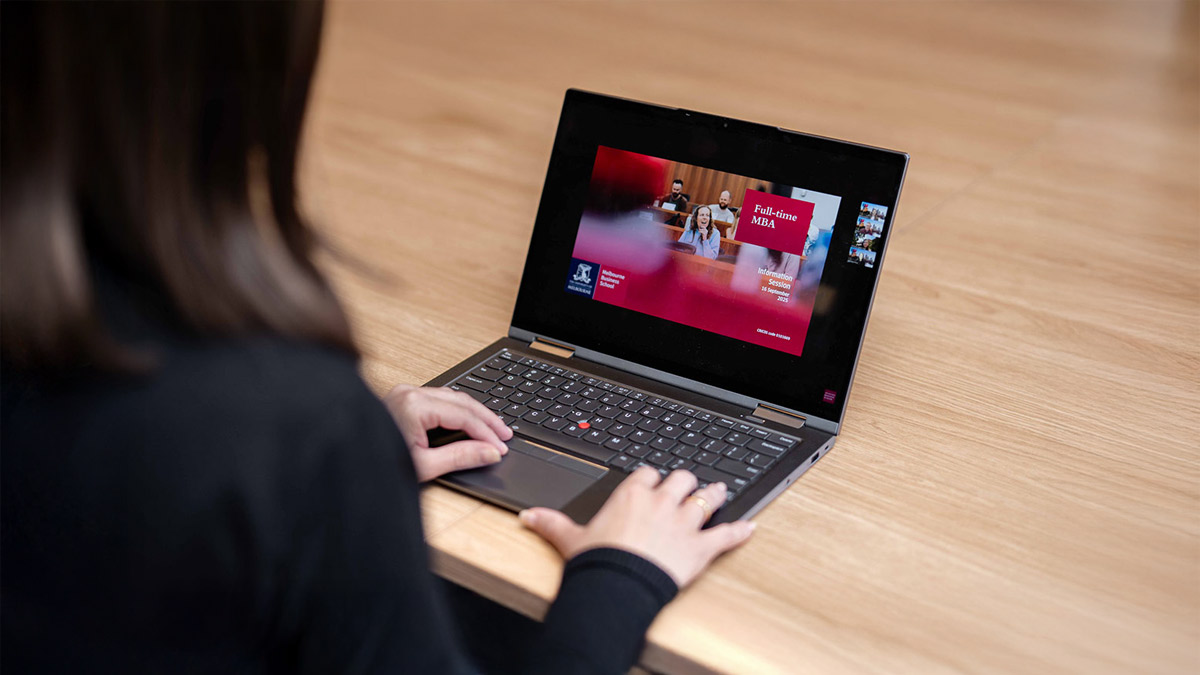
The best way to learn more about studying at Melbourne Business School is to attend an upcoming information session or book a one-on-one conversation with our recruitment team.
We hold sessions monthly, providing a comprehensive overview of everything you need to know about the program, along with an opportunity to participate in a group Q&A session. After this, if you need more specific information on subjects and study materials, campus life or assistance with your application, please book a one-on-one session. We are available to meet in person at our Carlton Campus or online.



Full-time MBA Degree Program FAQs
Full-time MBA Application Process and Selection Criteria FAQs
What are the application deadlines?
There are several application rounds for domestic and international students. Applications are assessed on a rolling basis. If you would like to be considered for scholarship, you should complete your application by the 3rd round. Please refer to the 2025 and 2026 Full-time MBA application deadlines.
Is there an application fee?
No, there is no application fee associated with the Full-time MBA application.
Are any of the rounds more or less competitive than others?
Applications are assessed across multiple rounds, with places and scholarships allocated progressively throughout the cycle. If you’re hoping to be considered for scholarships, we encourage applying as early as possible, as some scholarship applications close before the end of Round 3.
You can find full details on the scholarships page.
If my application has been unsuccessful, may I reapply in the next round?
Yes, you may reapply in a future intake. As applications are assessed holistically, we recommend reflecting on your overall application and strengthening it where possible before reapplying. If you have questions, you’re welcome to speak with a member of the Admissions team, who may be able to provide general guidance in some cases.
When will I hear if my application has been successful?
Typically, the assessment time for an application is up to four weeks if the Committee doesn't require additional information from you. You will be notified after the initial assessment stage is finalised to have an interview. Once your interview is complete, you will hear an outcome shortly after. To speed up the admission process, please ensure the following.
- A full undergraduate transcript is provided.
- A continuous work history in your CV. If there are any gaps, please provide an explanation.
- If your undergraduate GPA is not strong, an explanation or reflection upon your experience is beneficial.
Can I defer my admission?
In general, no. The available spot will be allocated to the candidates who can commence in the intake. If candidates cannot commence in the intake they applied for, they will need to re-apply for the following year and be considered with other candidates.
How can I strengthen my MBA application?
The Committee looks for four main competencies in your application - academic capacity, the ability to contribute and work effectively in teams, career progression and leadership potential.
What makes a compelling MBA personal statement?
The Committee assesses your academic capabilities and leadership potential. Original examples with details on how you make an achievement and/or how you reflect on an experience would be helpful. It's also important to know how you handle uncertainties, challenges and how you work with teams and stakeholders.
How do I prepare for an MBA interview?
You are highly recommended to conduct research on the Australian post-MBA job market and think about your career goals post-MBA. Please consider the MBA interview the same as a job interview when you will be asked to give examples to demonstrate your capabilities and suitability to the program.
Is there a minimum GMAT score required?
The minimum GMAT score required is 560, however meeting this threshold does not guarantee admission. On average, successful candidates have a GMAT score of around 680 (or a GMAT Focus score of approximately 635).
Candidates who have completed an undergraduate degree at an Australian or New Zealand university, completed in Australia or New Zealand, and who do not wish to be considered for an MBS scholarship, may be eligible for a GMAT waiver.
What is the language proficiency requirement?
Applicants whose previous studies were not completed in English are required to meet English language proficiency requirements, as outlined on the MBS website.
The school accepts TOEFL, IELTS Academic, PTE Academic, LanguageCert Academic, Michigan English Test and Cambridge English C1 Advanced. International students must demonstrate proficiency in English either through:
- IELTS overall score of 7.0, with writing 6.5; speaking 6.5; reading 6.5; listening 6.5; or
- TOEFL IBT score of 91, with writing 23; speaking 22; reading 19; listening 19; or
- PTE overall score of 72, with writing 65; speaking 66; reading 64; listening 64; or LanguageCert Academic overall score of 73, with writing 71; speaking 76; reading 65; listening 62; or Michigan English Test overall score of 62, with writing 64; speaking 53; reading 59; listening 59; or Cambridge English C1 Advanced overall score of 178, with writing 180; speaking 187; reading 168; listening 168.
Please refer to the University of Melbourne's Graduate English language requirements webpage for further information.
Is GRE score accepted?
Yes, GRE score is accepted. A minimum score of 157 on the Quantitative Section and a minimum of 152 on the verbal section are the minimum required score for GRE. Please refer to the Full-time MBA admission requirements.
Is online GMAT or GRE score accepted?
We accept online and face to face for GMAT. And only on case by case basis for GRE.
English is not my native language, but I have lived and worked in an English speaking country for many years. Do I still need to provide additional proof of fluency in English?
Please refer to the University of Melbourne's Graduate English language requirements to find out whether you meet the University's English language requirements and no not require submitting an English test result.
Can I apply before taking the GMAT/GRE?
It is strongly recommended to have the test result at the time of submitting as your application will not be marked complete and may be withdrawn. Applicants can start an application without taking the GMAT/GRE but they can't submit an application before their GMAT /GRE score is confirmed.
I have taken the GMAT/GRE more than once. Which score will you consider?
If you have reported more than one score, the Admissions Committee will still consider the full history of your GMAT / GRE attempts, but will place the greatest weight on the highest score you achieved. Also, if you have obtained a satisfactory percentile in one section of the test but a lower percentile in the other, and vice versa in a second test, the Admissions Committee may consider that you have reached a sufficient level overall, provided the second test does not show too significant a drop in the lower element.
Can I apply if I have less than the required work experience?
Candidates need to have at least two years of documented professional full-time work experience when they apply for the program. On average, full-time MBA students have 5 years of work experience.
Do I need business related work experience to apply?
Our MBA students come with diverse backgrounds, from public and private sectors and for-purpose organisations. Business-related work experience is valued and it will help you contribute to the classroom discussions. MBS values experience in various industries and roles, as long as it showcases relevant skills and leadership potential.
How many years of work experience do I need to be admitted?
The minimum requirement is two years of full-time professional work experience. However, most of our Full-time MBA students have more years of work experience. The average years of work experience prior to MBA is 5 years.
Full-time MBA Career Services FAQs
In which functional areas have students landed jobs?
The 2023 & 2024 Full-time MBA Classes have “Landed” Roles in the Following functional areas:
- Consulting: 38% (Mostly small, boutique consulting firms, not global firms)
- Financial Services: 15% (Banking, Investment Associate, Finance Controller. No PE/IB/VC hiring)
- General Management: 12% (Business Operations Managers)
- Marketing: 14% (Digital Product Manager, Account Executive, Category Manager)
- Operations: 10% (Project Engineer, Manager, Principal Performance & Improvement)
- Project Management: 6% (Strategy Associate, Head of Engineering, Strategic Project Manager)
- Sales: 3% (Director of Business Development, Business Development Executive)
- Engineering: 2% (Principal Engineer)
When can international students apply for full-time jobs?
International Full-time MBA students can only apply for permanent full-time jobs once they have completed the CORE Capstone class in August of their second year of study. They must also be in possession of the 485-visa.
How many students landed jobs in Australia?
Eighty-four percent of the 2024 class accepted jobs in Australia within 90 days of completing their studies (Students returned home to Japan, Pakistan, the United States, Indonesia).
What is the average Full-time MBA salary?
The average salary for the Full-time MBA classes of 2023 and 2024 is AUD $119,000.00 excluding superannuation. With superannuation the average salary was AUD $133,000.00.
How do students find jobs in Australia?
Most students find jobs based on targeted networking with alumni in the roles they want and the companies they want to work for. Very few land jobs via online applications. Many international students enter the Australia job market in a role that is like their previous employment. Gaining local experience before they can transition to a different industry and job function.
What job search support do FTMBA students receive?
Full-time MBA students are assigned a dedicated career coach to help them understand the Australian hiring landscape and gain important job search skills. This individual coaching reinforces the Personal Effectiveness Program content which is unique to Australian MBA schools.
Full-time MBA Course Information FAQs
What is the duration of the MBA program?
The Full-time MBA is a two-year program. Domestic students may choose to accelerate by increasing the workload and finish all subjects (except the Capstone subject) within a year or a year and a half upon completion of the Capstone subject with the cohort.
Are there opportunities for international exposure?
Yes, the School offers an exchange program. Students can choose to exchange at our partner schools. The School currently has exchange partnership agreements with 52 institutions across 23 countries or regions. Students can include a maximum of 50 credit points from the exchange program. More information can be found on our MBA Exchange Program page.
What is the cost of the MBA program?
The 2026 tuition fee is AUD $120,384 for international students and AUD $112,536 for domestic students. There are scholarships available. For further information, please refer to the questions about financial support.
How intensive is the coursework?
The course starts with two core modules (General Management 1 and General Management 2) taught intensively over 6 months. During the first 6 months, there are classes scheduled on most weekdays with optional tutorial sessions on Saturdays. After these modular subjects, the workload is less intensive to allow students to take internship opportunities and participate more in extra-curricular activities.
Can I specialise in a particular area?
There is no formal specialisation in the full-time MBA course. However, students may choose to specialise in a particular area with a choice of elective subjects. The School offers a wide range of electives in Finance, Marketing, Strategy, Operations and Organisational Behavious.
What is the teaching methodology?
The MBA teaching methodology is mostly case-based studies. Students are expected to integrate the learning and apply it to solve real business problems.
Are there opportunities for experiential learning?
Yes, there is a core subject, Immersive Business Experience, in the curriculum. Students are required to work at an Australian business to practice and apply their learning in a real workplace. Some electives also provide experiential learning opportunities, such as Innovation, BioDesign, etc.
Can I tailor my MBA?
Yes, we offer a wide range of elective subjects. You can tailor your elective choices as per your interest and career goals.
Full-time MBA Scholarship and Financial Support FAQs
What is the fee payment schedule?
Fee payment schedule is decided by the University of Melbourne. Typically students are required to pay their tution fee about 8 weeks before the subject commencement date.
What financial aid options are available?
The School offers generous scholarships for the Full-Time MBA program. All applicants are automatically considered for the MBS Scholarships. A full-fee scholarship is awarded to an international student. The School also has scholarships for indigenous students and women in Victoria.
Details are outlined on the Melbourne Business School Scholarships page.
What is the percentage of the class with a scholarshp and what is the average award?
As a general guide, 40% plus students will receive some financial support, ranging from AUD $5,000 to a full fee scholarship.
Can I be awarded more than one scholarship?
No. scholarships are generally not cumulated.
When will I be informed on the scholarship decision?
All students are automatically considered for the MBS Scholarship when their application is successful. You will be informed of the scholarship if you receive an offer. The Ian Harper AO Scholarship for Excellence is merit-based and has a separate application and selection process. If you would like to be considered for this prestigious full-fee scholarship that is available to international students, please submit your program application for admission and scholarship application by the end of round 3.
Details of scholarships available are outlined on the Melbourne Business School Schoalrships webpage.
When should I apply for scholarship?
There are multiple scholarships available for this course. Some are merit-based, and some are need-based, which provide opportunities to students who may not be able to commence higher education without financial support. The MBS offers scholarship for indigenous students, women in Victoria, and domestic and international students.
If you are an internatinoal student and would like to be considered for the merit-based full-fee scholarship (Ian Harper AO Scholarship for Excellence), you should submit your course application and scholarship application by the end of round 3.
Full-time MBA Selection FAQs
How competitive is the MBA admissions process?
The Full-Time MBA admissions are competitive. Strong academic credentials, work experience, leadership skills, and a compelling personal statement enhance chances of admission.
What are the admission requirements for the MBA program?
Entry requirements are:
- An undergraduate degree of 3 or 4 years minimum from a recognised tertiary institution; and
- At least two years of documented working experience; and
- A personal statement outlining why they wish to be considered for the course; and
- International students must demonstrate proficiency in English either through:
- IELTS score minimum requirement of 7.0 overall with no individual score less than 6.5; or
- TOEFL IBT score or TOEFL IBT score minimum of 102, and a written score minimum of 24 and no band less than 21; or
- PTE overall score minimum of 65, with writing skills of minimum 65 and no other communicative skill below 50; and
- Candidates who have not completed an undergraduate degree at an Australian or New Zealand University in Australia or New Zealand must demonstrate proficiency in analytical, quantitative, verbal and writing skills etc. either through:
- GMAT – minimum required 560; or
- GRE – minimum 310 with a minimum score of 157 on the Quantitative Section and a minimum of 152 on the verbal section
Applicants are also required to nominate referees. Meeting these requirements does not guarantee selection.
How can I learn more about the program before applying?
You may check the FAQs section to learn more about the program. You may also attend information sessions. If you have any questions, you are most welcome to reach out to the Student Recruitment team for information. When you visit Melbourne, you are most welcome to book an appointment to have a school tour and/or sit in an MBA class.
Are interviews part of the admission process?
Yes, the interview is part of the admission process. The Committee reviews the outcome of the interview before a final decision is made on your application. We strongly encourage you to prepare for the interview to strengthen your application.
How important is my undergraduate GPA?
The undergraduate GPA is important. However, this is not the only factor that the admission committee considers. The Committee also reviews your work experience, GMAT/GRE scores, leadership, and personal achievements. If your undergraduate GPA is not strong, an explanation of your undergraduate performance and how you have progressed and developed academically and professionally since your graduation will be beneficial.
What types of references does MBS accept?
Your referees should be individuals you have worked with closely over an extended period. Referees should not include family members, close friends, or personal acquaintances. Some examples of referees include your current manager, former manager, senior colleague, client or business partners.
When do my references need to be submitted?
Referee reports must be received before you can submit your application, prior to the application deadline. We recommend reaching out to your referees early to avoid any delays in the process.
What will my references need to submit?
Once you submit your referee’s contact details via the application form, they will be sent a short confidential report to complete. This includes rating your skills and providing comments on your professional capabilities. The report typically takes around 15 minutes to complete.
Full-time MBA Student Experience FAQs
What career support services are provided?
The School has a Career Management Centre that provides career services and support to students. There is also a personal effectiveness program included in the core component of the course where Career Management Centre coaches students how to get ready for their post-MBA jobs.
What is the typical class profile?
The MBA course attracts applicants from diverse backgrounds.
Are there opportunities for internships during the program?
Yes, there is an optional internship opportunity available as part of the Full-Time MBA experience. This allows students to apply their learning in a practical, real-world setting and gain valuable industry experience.
Our Career's Team works closely with students to identify and secure internship opportunities aligned with their career goals. These internships provide an immersive experience and can serve as a pathway to post-MBA employment.
How does the program support entrepreneurship aspirations?
There is a mandatory topic, Innovation, included in the core module. In this subject, students will learning how to conceptualise and articulate a coherent strategic, marketing and financial plan for an innovation, clearly and concisely communicate the ideas on how to manage and commercialise an innovation.
What is the alumni network like?
The School's alumni community is a uniquely talented and influential group of more than 10,000 alumni in over 80 countries. Please feel free to reach out to our alumni network to ask about their experience as an MBS MBA student.
Are there student clubs and organisations?
Yes, the School has a Student Representative Council with student-led clubs ranging from consulting, entrepreneurship, women and leadership, to sporting and social clubs. There are extra-curricular opportunities available, ranging from case competitions, debate, to soccer games between faculty and students.
Are there opportunities for leadership development?
Yes, the curriculum includes topics such as Leadership, Personal Effectiveness Programs, Immersive Business Experience, etc. for you to develop and demonstrate your leadership skills. Each subject has a syndicate project where you also apply leadership knowledge and skills to show self-leadership and peer leadership. This syndicate experience also provides you with the opportunity to grow both personally and professionally.
How diverse is the student body?
Diversity is a key feature of the MBS MBA. We have students from diverse backgrounds in terms of age, culture, gender, work experience and academic background.
How are groups and teams structured?
Syndicate groups are assigned for each subject. You will be working with different students each module/term to build and extend your network. To ensure there is a balanced and diversed work group to maximise your learnings from your peers, your industry background, academic background and personal background are considered when determining group allocation.
What is the policy on class attendance?
As a Full-time MBA student, you are expected to attend 100% of classes in person. If you are international students, you are also required to meet the attendance requirements as set in your Student Visa conditions.
Are there opportunities to study abroad?
Yes, the School offers an exchange program. Students can choose to exchange at our partner schools. The School currently has exchange partnership agreements with 52 institutions across 23 countries or regions.
Can I work while pursuing a Full-time MBA?
Students cannot work full-time while pursuing the Full-time MBA. During the first 6 months of the course, managing a part-time job and the intensive full-time study may be challenging too. When the study load is less intensive, students may work part-time. International students can only work for a limited hours per fortnight as per the conditions of the visas. The exception here is when you have an internship during the elective stage. You may work full time and meet the study load requirement.
How much time should I dedicate to MBA course work each week?
The first two modules in the MBA course are very intensive. You will have two lectures every day with some career development activities. Optional tutorial sessions are usually held on Saturdays. After the first two modules, you may have 2 - 3 lectures in a week, depending on how you pace your studies. Outside the classroom hours, you will spend time working with your syndicate group on syndicate projects and other extra-curricular activities.
I'm interested in developing my career in sustainability. Any opportunities for participation in the Centre of Sustainability and Business' activities?
Sustainability is built into our curriculum. There is an elective "Managing Sustainability for Strategic Advantage" available in the MBA course. The centre organises seminars, networking events and short courses. Our Full-time MBA students are welcome to attend these activities and explore other opportunities that may available.
I'm interested in Data Analytics. Any opportunities for participation in the Institute for Digital Innovation & AI?
Data Analytics is built into our curriculum. We have multiple Data Analytics electives available in the MBA course. The centre organises seminars, networking events and short courses. Our Full-time MBA students are welcome to attend these activities and explore other opportunities that may available.
What is a typical day of an Full-time MBA student like at Melbourne Business School?
There is no typical day as the schedule will change every day throughout the year. During the first two core modules (first 6 months in the course), they often have 1 class each day, Monday to Friday, starting at around 9:30am and finishing around 5:00pm. Students also have assignments and group projects, career counselling sessions and extra-curricula activities. When you are eligible to enrol in elective subjects, each student has their own academic schedule depending on the electives he or she has chosen, with the same amount of assignments and group work, and typically increasing time spent on career related activities.
Want to know more?
Speak to one of our Future Learners team who can assist you with choosing the right MBA to support your career journey.
Call us on +61 3 9349 8200, or send us a message on the form below and we'll respond within three business days.
Related Programs and Courses

Full-time MBA
Management
Full-time MBA
Australia's top-ranked MBA in an immersive format that will develop your full potential to succeed.
Part-time MBA
Management
Part-time MBA
A flexible, top-ranked MBA with study options that make it easier than ever to get started.

Online MBA
Management
Online MBA
Australia's top-ranked MBA in an immersive format that will develop your full potential to succeed.

Full-time Master of Business Analytics
Data
Full-time Master of Business Analytics
Our degree for aspiring data professionals, with a focus on personal skills as well as technical expertise.

