
MBS partners with Coles, Wesfarmers, Orica and BHP

Melbourne Business School has partnered with four leading ASX 100 companies to support the long-term prosperity of the country’s economy and social wellbeing as it navigates the sustainability transition.
Coles, Wesfarmers, Orica and BHP have joined as founding partners of the School’s new Sustainable Value Creation Institute as leading businesses creating long-term value through improving economic, environmental and societal outcomes.
Melbourne Business School Dean Professor Jenny George said that collaboration to advance best practice across industries was essential if Australia was going to drive systemic change.
“Many businesses are scattering their sustainability and social efforts and failing to maximise financial impact. Industry must work together to define and address the common challenges they each face and the barriers to scaling their efforts.”
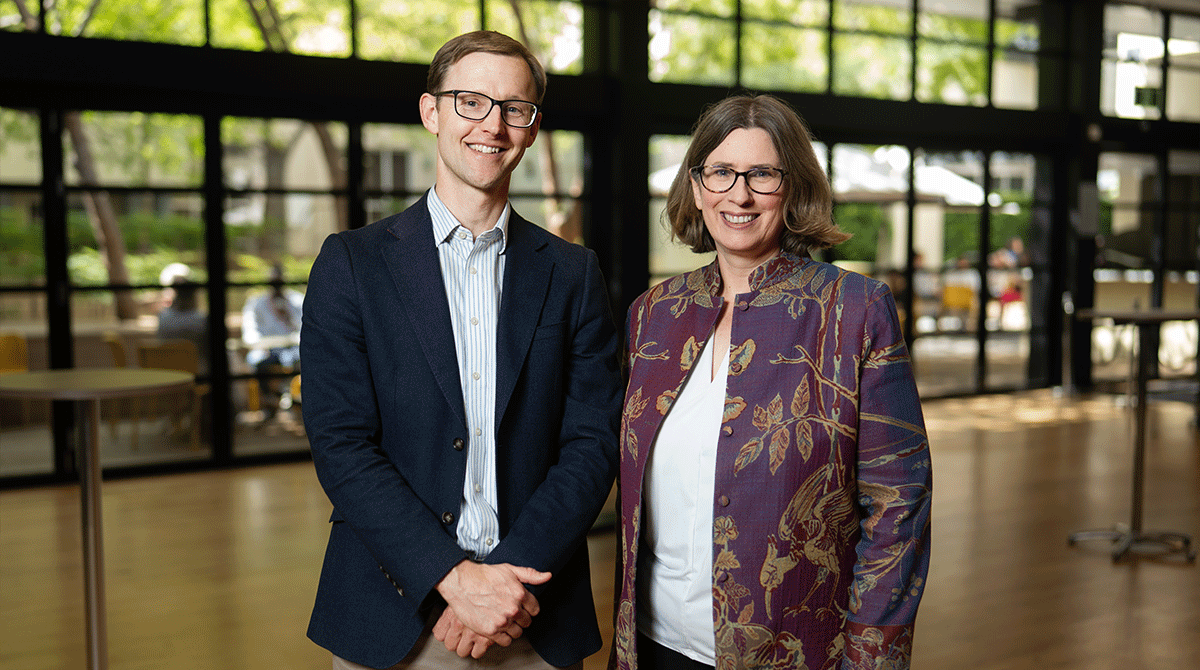
The Institute will be headed up by Professor Will Harvey to conduct research addressing current problems facing the business community regarding creating sustainable value, build the leadership capability of Australian boards and management, and convene Australia’s top executives for cross-sector dialogues.
“By partnering with four iconic Australian companies that are embedding sustainable value creation in their competitive strategies, we aim to help corporate Australia navigate the sustainability transition and strengthen our national competitiveness,” Professor Harvey said.
Coles, Wesfarmers, Orica and BHP are each driving significant initiatives at scale in climate change and decarbonisation, nature and community impact.
In 2020, Wesfarmers retail business committed to use 100 per cent renewable electricity and adopted net zero emissions targets by 2030.
“The Institute’s focus on the long‑term challenges shaping the operating environment for Australian businesses is well aligned with Wesfarmers’ approach to sustainable value creation. As a founding partner, we see this collaboration as an investment in leadership and thinking that supports long‑term value creation,” Wesfarmers Managing Director Rob Scott said.
Coles Group has achieved its target to source 100% renewable electricity for operations by 2025, and has removed over 600 million pieces of conventional plastic from its own-brand packaging since 2021.
Coles Group CEO and Managing Director Leah Weckert said they looked forward to working with the Institute and partners across sectors to help drive real progress.
“Australia’s leading businesses have an important role to play in creating sustainable value by driving progress on climate, nature and circularity while strengthening communities.
That means making smart decisions today and building sustainability and community impact into how we run our businesses every day,” she said.
Orica, one of the world’s leading mining and infrastructure solutions providers was recently recognised with the 2024 Sustainability Leaders Award for its work on sharply abating emissions from its three nitric plants on Kooragang Island.
“At Orica, sustainability is fundamental to how we operate and how we create long-term value. Addressing the complex challenges of the transition to a low-carbon future requires collaboration between customer's, industry and research. The Sustainable Value Creation Institute plays an important role in building the leadership capability needed to translate sustainability ambition into practical, scalable outcomes,” Orica Group Executive and President of AUSPAC & Sustainability Germán Morales said.
Social value is what BHP calls its positive contribution to society and is a core component of its business strategy. As part of its climate change strategy, BHP’s long-term goal is to achieve net zero operational greenhouse gas (GHG) emissions (Scope 1 and 2 emissions from its operated assets) by 2050, with a target to reduce its operational GHG emissions by at least 30% by FY2030 from an FY2020 baseline.
“The most meaningful outcomes are not driven by isolated initiatives, and this Institute will be a bridge connecting business with universities, communities and civil society.
From a business perspective, sustainable value is created through the way we work every day at a local level, how our strategy is set and capital is allocated, and how we measure value. When those systems are built for the long term with local community at the centre, value compounds for society as well for company performance.”
BHP Chief Legal, Governance and External Affairs Officer Caroline Cox said. Professor Harvey said these businesses were leading the way in their strategic pursuit of long-term shareholder value while actively enabling sustainability transitions.
Find out more or get in touch with the new Institute by emailing [email protected].