
Informed healthcare leadership is key to driving change

The annual Collaborative Symposium from Bastas Academy for Health Leadership and the UCL Global Business School for Health examined how the sector can move past data paralysis.
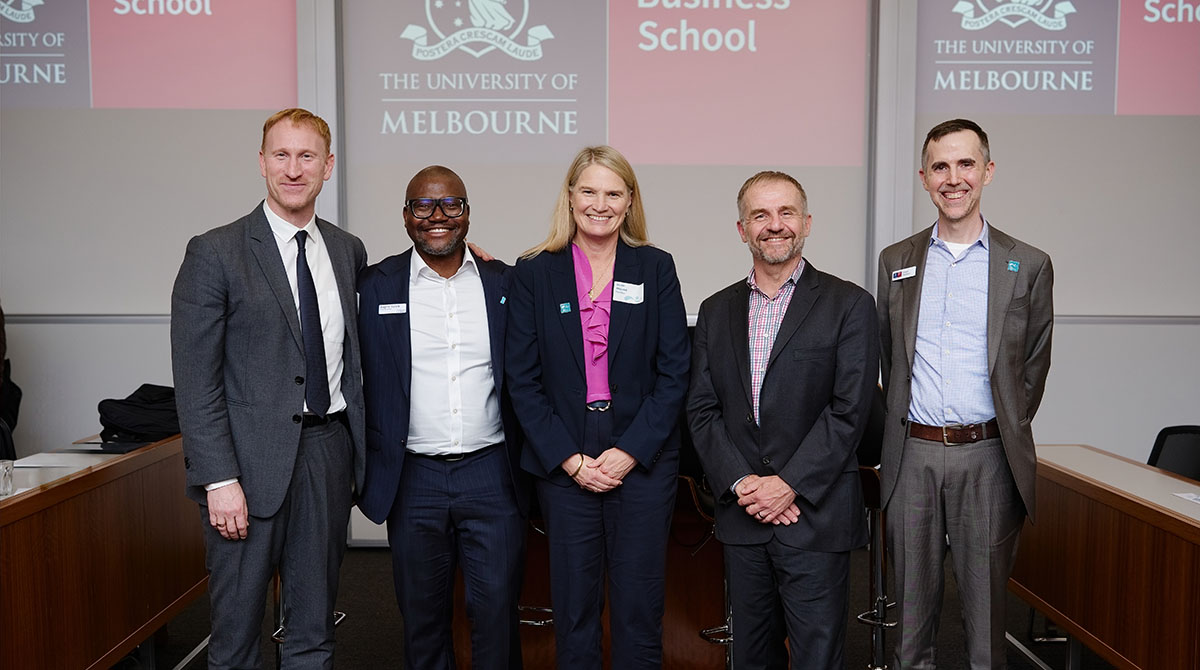
How can we move past data paralysis towards meaningful, sustainable change in the health sector?
That was the question that was posed at the annual Collaborative Symposium between the Bastas Academy for Health Leadership (BAHL) and the UCL Global Business School for Health that brought together a mix of health care leaders and professionals to discuss the topic, Moving from Data to Change.
The evening highlighted a critical insight: while high-quality data is a marker of progress, real impact depends on how leaders interpret and act on it.
Authentic leadership in the age of data and AI
Keynote speaker Professor Peter Steel, incoming Director of the University of Melbourne’s Centre for Digital Transformation of Health and the Chief Transformation Officer at The Royal Melbourne Hospital, captured this challenge, noting that success in the digital era hinges on two parallel priorities: better data and greater capability.
“I hope we can all agree on two consensus goals of contemporary health care,” Professor Steel said.
“Usable, connected, decision ready data and a workforce capable of leveraging that data as a strategic asset.”
However, he cautioned that the current system is not set up for success.
While electronic medical records (EMRs) have transformed healthcare from its paper-based past, they were not designed for the level of system-wide analytics now required. As expectations for data-driven decision-making and AI accelerate, investment in analytics infrastructure has not kept pace.
As a result, health systems face mounting costs and complexity in turning raw data into actionable insight.
“In Australia, limited funding, the absence of a formal clinical informatics specialty, and overburdened central analytics teams risk creating a system that is rich in dashboards but maybe poor in innovation,” Professor Steel said.
“Turning data into a strategic asset requires another critical problem to be addressed, and that’s workforce capability.”
Applied business analytics in healthcare decision-making
The solution, he argued, lies in embedding analytics expertise within clinical teams and upskilling frontline staff in data science. He called for a more distributed, democratised approach to data use, one that maintains central governance while empowering clinicians to drive innovation locally.
“The goal is to shrink the central analytics function… and embed more of the analytics workforce into individual clinical services, a hub and spoke model of analytics.”
Beyond what needs to be built, Professor Steel also emphasised that leaders need to be strategic about what to stop doing. “Leaders should be challenged to ask: what low-value data activity, reporting, or investment can we discontinue?,” he said.
“Creating space for the right investments requires stopping the wrong ones.”
Healthcare transformation is more than technical solutions
Following the keynote address, Professor Robert Saunders, Director BAHL hosted a panel discussion featuring:
- Professor Eugine Yafele, Chief Executive Officer, Monash Health
- Jackie McLeod, Chief Operating Officer, Royal Melbourne Hospital
- Professor of Leadership and Management for Healthcare Nora Colton, Director, UCL Global Business School for Health
- Stéphane Chatonsky, Non-Executive Director & Board Chair, Technology, Digital Health and AI.
The panel reinforced Professor Steel’s message that digital transformation is not purely technical, but depends on workforce engagement, patient trust, adoption, and effective change management.
“Data can help us expose the problem, but it’s got to be the people who are the ones that are driving forward the solution,” Professor Colton said.
They highlighted that sustainable digital health improvement requires aligning technology with strategy, workflow redesign and measurable outcomes, rather than adding tools onto already stretched systems.
Leadership, trust and the future of digital health
Central to this is the need for good leaders, capable of understanding enough about data and AI to ask the right questions and align investments with organisational priorities and real patient needs.
Panellists warned that without this, organisations risk fragmented, low-impact initiatives driven by “shiny” technologies rather than meaningful outcomes.
As Professor Yafele summarised: “we need a healthy dose of scepticism, good judgment and an assessment of what the real problem is, before we assign a solution.“
To learn more about the Bastas Academy of Health Leadership and the courses they offer, visit their website.
If you are interested in undertaking specific courses in understanding Data Analytics or AI, visit our Short Courses page.

Bastas Academy for Health Leadership
Equipping health leaders from Australia and around the world with knowledge and skills to transform the health sector.
Education
Equipping health leaders from Australia and around the world with knowledge and skills to transform the health sector.

